

 22-Jun--2026
The face shield market size has grown rapidly in recent years. It will grow from $4.4 billion in 2025 to $4.97 billion in 2026 at a compound annual growth rate (CAGR) of 13.1%. The growth in the historic period can be attributed to increased healthcare safety requirements, expansion of medical and dental services, growth in industrial safety standards, availability of low-cost plastic materials, scaling of mass PPE manufacturing.
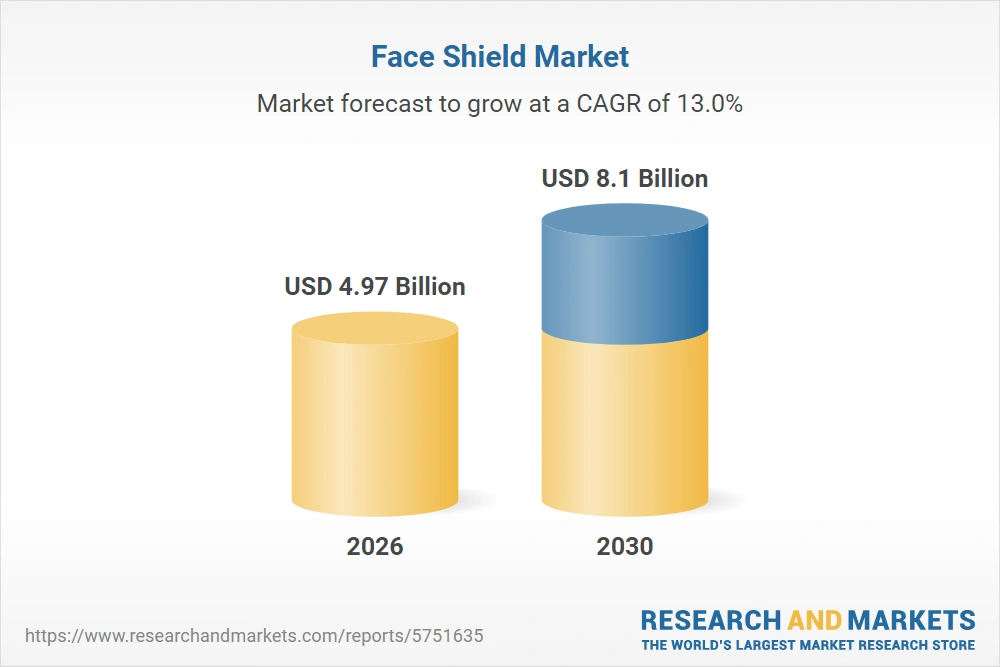
The face shield market size is expected to see rapid growth in the next few years. It will grow to $8.1 billion in 2030 at a compound annual growth rate (CAGR) of 13%. The growth in the forecast period can be attributed to increasing focus on sustainable PPE solutions, rising demand from industrial safety applications, expansion of infection control protocols, growing adoption of reusable protective equipment, increased investment in advanced PPE materials. Major trends in the forecast period include increasing adoption of reusable face shields, rising demand for anti-fog and anti-scratch designs, expansion of biodegradable shield materials, growing customization for medical and industrial use, enhanced focus on user comfort and visibility.
Heightened awareness following the COVID-19 pandemic, along with various government initiatives, has contributed to the growth of the face shield market. According to the World Health Organization (WHO), COVID-19 spreads through droplets of saliva released when an infected individual coughs or sneezes. Increased awareness emerged due to surges in COVID-19 cases and the lockdown measures implemented by governments worldwide. In addition, government-led initiatives aimed at reducing virus transmission supported the adoption of protective equipment such as face shields. For example, in July 2024, according to the World Health Organization, a Switzerland-based intergovernmental organization, global coverage of the first dose of the HPV vaccine for girls increased from 20% in 2022 to 27% in 2023. Thus, heightened public awareness and supportive government actions driven by the COVID-19 outbreak played a key role in advancing the face shield market.
Companies operating in the face shield market are increasingly focused on introducing innovative products, such as fog-resistant and ergonomically designed face shields, to improve visibility, comfort, and protection in hazardous working environments. Fog-resistant face shields incorporate permanent anti-fog coatings and ergonomic mounting systems that help minimize condensation on the visor surface, offering better comfort and a clearer field of vision compared with conventional shields. For instance, in June 2024, Studson, a US-based personal protective equipment manufacturer, launched a new range of face shields designed specifically for compatibility with the SHK 1 full-brim safety helmet. These products provide enhanced protection and comfort for applications such as welding, cutting, and high-impact tasks. The range includes Arc Flash Tint Welding Shields, Clear Shields, and Shade 5 Green Tint Shields, featuring ergonomic weight-balancing slotted cap brackets, a LeverLock attachment system for quick replacement, toric-shaped lenses for expanded visibility, and permanent anti-fog and anti-abrasion coatings that ensure long-lasting clarity and reduced maintenance in demanding work conditions.
In April 2024, Ansell, a US-based manufacturing company, acquired Kimberly-Clark for an undisclosed amount. Through this acquisition, Ansell aims to strengthen its growth strategy and enhance its market position in scientific and industrial segments by leveraging Kimberly-Clark Personal Protective Equipment’s established brands and product portfolio. This move is expected to generate operational synergies and improve overall customer differentiation. Kimberly-Clark is a US-based manufacturing company known for producing a wide range of consumer and professional products.
Major companies operating in the face shield market are Minnesota Mining and Manufacturing Company, Honeywell International Inc., Kimberly-Clark Corporation, Mine Safety Appliances Company, Alpha Pro Tech Ltd., Lakeland Industries Inc., Pyramex Safety Products LLC, Karam Safety Private Ltd., Gateway Safety Inc., MCR Safety LLC, E.D. Bullard Company, Key Surgical LLC, Radians Inc., Surewerx USA Inc., Crosstex International Inc., JSP Safety Ltd., Lindstrom Group, HexArmor, Protech Medical Inc., National Safety Apparel Inc., Steelbird Hi-Tech India Ltd., Sellstrom Corporation, Dynamic Safety USA LLC.
Asia-Pacific was the largest region in the face shield market in 2025. This region is expected to continue to be the fastest-growing region in the forecast period. The regions covered in the face shield market report are Asia-Pacific, South East Asia, Western Europe, Eastern Europe, North America, South America, Middle East, Africa. The countries covered in the face shield market report are Australia, Brazil, China, France, Germany, India, Indonesia, Japan, Taiwan, Russia, South Korea, UK, USA, Canada, Italy, Spain.
The face shields market consists of sales of full-face shields, half-face shields, polyvinyl chloride, and polybutylene terephthalate. Values in this market are ‘factory gate’ values, that is the value of goods sold by the manufacturers or creators of the goods, whether to other entities (including downstream manufacturers, wholesalers, distributors and retailers) or directly to end customers. The value of goods in this market includes related services sold by the creators of the goods.
The market value is defined as the revenues that enterprises gain from the sale of goods and/or services within the specified market and geography through sales, grants, or donations in terms of the currency (in USD unless otherwise specified).
The revenues for a specified geography are consumption values that are revenues generated by organizations in the specified geography within the market, irrespective of where they are produced. It does not include revenues from resales along the supply chain, either further along the supply chain or as part of other products..
