

 05-Feb--2026
Disposable face shields have become an essential component of personal protective equipment (PPE) across healthcare, industrial, and hygiene-related environments. While often used alongside medical masks, face shields serve a distinct purpose and offer a different type of protection. Understanding what a disposable face shield is and when it is needed helps healthcare providers, safety managers, and procurement professionals make informed decisions in 2026.
What Is a Disposable Face Shield?
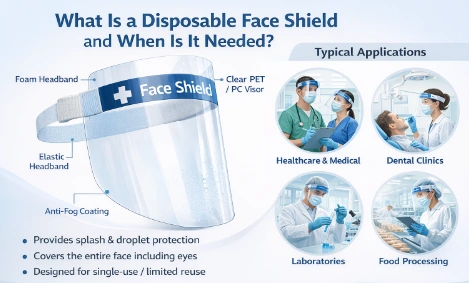
A disposable face shield is a protective device designed to cover the entire face, typically extending from the forehead down to below the chin and wrapping around the sides of the face. It acts as a physical barrier against splashes, droplets, and other liquid contaminants that may come into contact with the eyes, nose, and mouth.
Most disposable face shields are made from transparent plastic materials such as PET or polycarbonate (PC). These materials provide high clarity, lightweight performance, and impact resistance. A typical design includes a clear visor, a foam or soft padding at the forehead area, and an elastic band or adjustable strap to secure the shield in place.
Disposable face shields are generally intended for single use or limited-duration use, depending on the application and hygiene requirements. They are widely used in environments where splash protection and facial coverage are necessary.
What Does a Disposable Face Shield Protect Against?
Unlike medical masks or respirators, face shields do not filter airborne particles. Instead, their primary function is to provide barrier protection.
A disposable face shield helps protect against:
Splashes of bodily fluids
Droplets from coughing, sneezing, or speaking
Chemical or liquid splashes in laboratory settings
Accidental contact with contaminated surfaces
By covering the eyes and face, face shields reduce the risk of exposure through mucous membranes, which are a common entry point for infectious agents.
Face Shields vs. Masks: Different Roles, Complementary Use
Face shields and masks are often misunderstood as interchangeable products, but they are designed for different protective roles.
Medical masks primarily reduce the transmission of respiratory droplets from the wearer and provide limited protection against incoming droplets. Face shields, on the other hand, block direct splashes and protect the entire facial area, including the eyes.
In many professional settings, face shields are used together with medical masks to provide layered protection. This combination helps address multiple exposure pathways and is widely adopted in healthcare and hygiene protocols.
When Is a Disposable Face Shield Needed?
Disposable face shields are commonly used in situations where there is a risk of splashes, sprays, or close contact. Typical applications include:
Healthcare and Medical Settings
Face shields are frequently used by doctors, nurses, and medical staff during procedures that may generate splashes or sprays. They are also used in outpatient care, emergency rooms, and isolation areas to enhance facial protection.
Dental Clinics
Dental procedures often involve close proximity to patients and exposure to saliva or fluids. Face shields provide an additional protective layer for dental professionals while allowing clear visibility.
Laboratories
In laboratories, face shields help protect against chemical splashes, biological samples, and accidental spills. Disposable options are preferred when contamination risk is high.
Food Processing and Hygiene Control
Face shields are used in food processing environments to prevent contamination and protect workers during hygiene-sensitive operations.
Industrial and Occupational Safety
In certain industrial environments, face shields provide protection against splashes, dust, or debris. Disposable shields are suitable for short-term tasks or visitor use.
Key Features to Consider When Choosing a Disposable Face Shield
For buyers and importers, selecting the right disposable face shield involves evaluating several practical factors:
Material clarity: High transparency ensures unobstructed vision
Anti-fog performance: Reduces visibility issues during extended use
Comfort: Lightweight design and soft forehead padding improve wearability
Fit and stability: Secure headbands help maintain proper positioning
Coverage area: Adequate length and width provide better facial protection
Comfort and usability have become increasingly important, especially in environments where face shields are worn for extended periods.
Disposable vs. Reusable Face Shields
Disposable face shields are often preferred in healthcare and hygiene settings because they reduce the risk of cross-contamination and eliminate the need for cleaning or disinfection. Reusable face shields may be used in lower-risk environments where proper cleaning procedures can be maintained.
The choice between disposable and reusable options depends on hygiene requirements, cost considerations, and operational practices.
Considerations for Procurement and Export
When sourcing disposable face shields for international markets, buyers should consider:
Product specifications and material safety
Consistency in manufacturing quality
Packaging and labeling compliance
Supply reliability and lead time
Intended usage scenarios
Clear product documentation and stable quality are key factors in meeting the expectations of global buyers.
Conclusion
Disposable face shields play a vital role in protecting the face and eyes from splashes and droplets in a wide range of professional environments. While they do not replace masks or respirators, they complement other protective equipment and contribute to a more comprehensive protection strategy.
By understanding when and how disposable face shields are used, organizations can make informed decisions that support safety, hygiene, and operational efficiency in 2026 and beyond.
